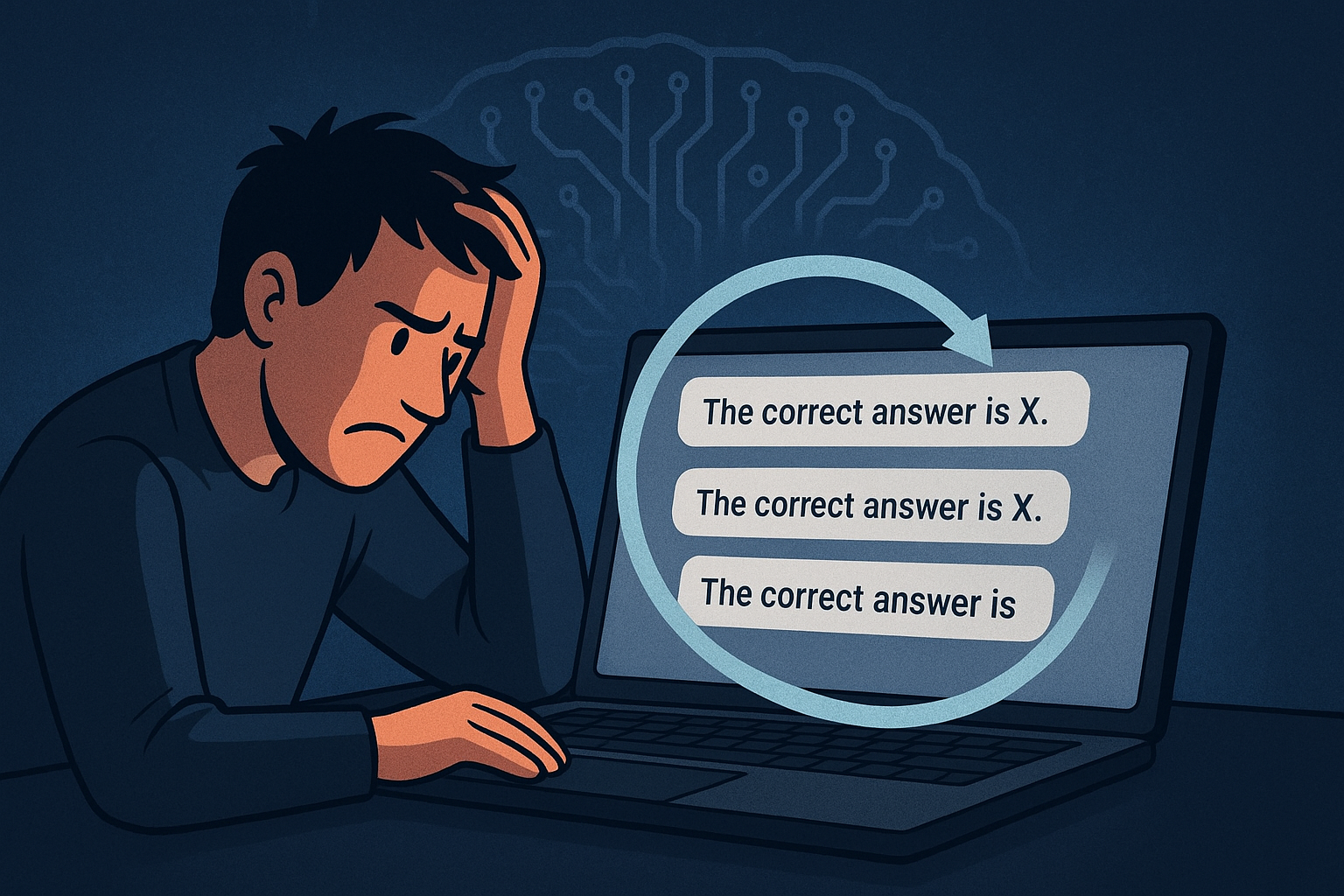
AI chatbots give wrong answers because they generate responses based on patterns in training data rather than verified facts. These mistakes are commonly known as AI hallucinations, LLM hallucinations, or generative AI errors, and they remain one of the biggest challenges affecting chatbot accuracy and AI reliability. As large language models (LLMs) become more common in enterprise AI chatbots, improving AI reliability and reducing misinformation have become major priorities for organizations.
AI responses depend on learned patterns and available information sources, so they may sometimes produce incomplete or inaccurate answers. This is why outputs can sound accurate while still being incorrect.
This becomes a serious issue because AI chatbots are now widely used in customer support, education, content creation, and business workflows. In these real-world applications, users often trust fluent and confident responses without verifying them, which increases the risk of misinformation being accepted as fact.
The gap between fluent language and factual accuracy is the core reason AI chatbots produce unreliable outputs. It affects trust, decision-making, and operational quality when AI is used without proper verification systems.
To understand this problem clearly, it is important to break down exactly how and why these systems fail in predictable ways.
Why AI Chatbots Give Wrong Answers
AI chatbots give wrong answers because they generate responses by predicting the most likely text based on patterns in training data, not by verifying facts. The quality of the response depends heavily on the data available and how the question is interpreted
This issue becomes especially visible in real-world environments such as customer support systems, education platforms, and business tools, where users rely on accuracy but receive fluent responses that are not always grounded in verified information. These failures are not random. They come from specific, repeatable limitations in how AI systems are built and how they process information.
Prediction-Based Text Generation
-
AI chatbots generate responses by predicting patterns in language. They do not understand information like humans, so they can sometimes create incorrect connections between concepts.
Lack of Real Understanding
AI systems do not understand meaning like humans.
-
They detect patterns in language, not real-world truth
-
They cannot verify whether a statement is correct
-
They may combine unrelated concepts into one response
This leads to believable but incorrect outputs.
Training Data Limitations
AI models depend entirely on the quality of their training data.
-
Data may be incomplete, outdated, or biased
-
Conflicting sources can produce inconsistent answers
-
Low-quality data can still influence outputs
Weak data directly reduces response accuracy.
Outdated Knowledge
Most AI chatbots do not update knowledge in real time.
-
They may miss recent events or changes
-
Knowledge cutoff limits current awareness
-
Fast-changing topics often produce incorrect results
-
This creates confident but outdated answers.
For example, a chatbot trained before a major product launch, policy update, or regulatory change may continue providing outdated information until its knowledge is refreshed or connected to a real-time data source.
Prompt Misinterpretation
User input strongly affects output quality.
-
Vague prompts force the model to guess intent
-
Missing context leads to incomplete reasoning
-
Small wording changes can change results significantly
Many errors come from unclear questions, not system failure.
Why AI Chatbots Don’t Say “I Don’t Know”
AI systems are trained to respond even when uncertain.
-
They are optimized for helpful, complete answers
-
They may guess instead of refusing
-
Uncertainty is not always clearly expressed
This increases the risk of confident but incorrect responses.
AI Hallucinations (LLM Hallucinations) with Real Examples
AI hallucinations, also called LLM hallucinations, occur when a chatbot generates information that is false, misleading, or unsupported by any reliable source. These generative AI errors can significantly reduce chatbot accuracy and user trust.
This becomes a serious issue in real-world applications such as customer support systems, education tools, and business workflows. In these environments, users often trust fluent and well-structured answers without verifying them, which increases the risk of false information being accepted as correct.
Real Example : In 2023, two lawyers representing a client in a federal court case used ChatGPT to assist with legal research. The AI generated several court cases that appeared legitimate but did not actually exist. The lawyers submitted these fabricated citations in a legal filing without verifying them. When the court discovered the cases were fake, the lawyers were sanctioned and fined $5,000. The incident became one of the most widely cited examples of AI hallucinations in professional settings and demonstrated the risks of relying on AI-generated information without verification.
These errors usually happen because of limitations in data, prompts, or missing context.
Fake Facts and Invented Information
AI can generate completely false statements that do not exist in real-world data.
-
Non-existent events or claims
-
Incorrect historical or scientific explanations
-
Fabricated concepts that sound realistic
Fabricated Citations and Sources
AI may generate references that look real but do not exist.
-
Fake research papers or articles
-
Incorrect author names or publication details
-
Misleading or unverifiable sources
Incorrect Statistics and Data
AI can generate numbers that are not accurate or verified.
-
Wrong percentages or market figures
-
Misleading research or survey data
-
Estimated values presented as facts
Real Example: Researchers have found that large language models can invent statistics, research findings, and academic references that appear credible but cannot be verified in the original sources. This highlights the importance of fact-checking AI-generated numerical claims before using them in reports or business decisions.
Misleading Technical or Product Information
In technical or business contexts, hallucinations can affect decision-making.
-
Incorrect product features or specifications
-
Wrong software behavior explanations
-
Outdated or invented documentation details
Confident but Incorrect Explanations
One of the most critical issues is tone-based trust.
-
Answers are delivered in a confident, complete format
-
No uncertainty signals are shown
-
Users assume correctness due to fluent language
How to Reduce Wrong Answers from AI Chatbots
AI chatbots produce fewer wrong answers when their outputs are grounded in reliable data, guided by clear instructions, and supported by validation systems. Businesses can improve these workflows with AI solutions for businesses that help automate processes and deliver more reliable AI experiences.
While errors cannot be fully eliminated, accuracy can be significantly improved by controlling how information is retrieved, generated, and verified before it is used in real-world applications.
In production environments such as customer support systems, business tools, and AI assistants, reducing wrong answers depends on combining better prompting, structured data sources, and retrieval-based architectures. Without these controls, chatbots continue to rely heavily on probabilistic text generation, which increases the risk of incorrect responses.
The following methods are the most effective ways to improve accuracy and reduce unreliable outputs
Improve Prompting Techniques
Clear and structured prompts directly improve output quality.
-
Define the task clearly and specifically
-
Provide relevant context and constraints
-
Avoid vague or multi-meaning questions
Use Verified Knowledge Sources
Grounding AI in trusted data reduces hallucinations.
-
Use official documentation or curated datasets
-
Avoid relying only on raw model memory
-
Keep information sources updated and consistent
Verified sources improve factual reliability.
RAG Systems (Retrieval-Augmented Generation)
Retrieval-Augmented Generation (RAG) connects AI models to external knowledge sources before generating answers. RAG is one of the most effective techniques for improving AI reliability and reducing hallucinations in production systems.
-
The system retrieves relevant documents first
-
Responses are generated based on real data, not assumptions
-
Reduces hallucinations significantly in production systems
Human-in-the-Loop Oversight
Human validation improves trust and accuracy.
-
Humans review or approve AI outputs
-
Errors are corrected before deployment or delivery
-
Essential for high-risk or customer-facing systems
Structured Knowledge Base Design
Poor data structure leads to inconsistent answers.
-
Organize information clearly and logically
-
Remove duplicate or conflicting content
-
Regularly update and audit knowledge bases
Controlled Confidence and Uncertainty Handling
Reducing overconfident guessing improves reliability.
-
Allow AI to express uncertainty when needed
-
Enable fallback responses like “I don’t know”
-
Avoid forcing answers in unclear situations
When AI Should Refuse to Answer (But Doesn’t)
AI chatbots should refuse to answer when the question is unsafe, unclear, or outside reliable knowledge boundaries. However, many systems still generate responses instead of refusing because they are optimized to stay helpful and produce an output. This creates a risk where the model guesses instead of acknowledging uncertainty.
This behavior becomes critical in real-world use, especially in medical, legal, financial, and technical scenarios where incorrect answers can lead to serious consequences. Instead of clearly stating limitations, AI may still produce a confident response that appears valid but is not grounded in verified information.
Understanding when refusal should happen is key to improving AI safety and reducing misleading outputs.
High-Risk Topics (Medical, Legal, Financial)
AI should refuse to provide definitive guidance in sensitive domains.
-
Medical diagnosis or treatment decisions
-
Legal interpretations or case predictions
-
Financial investment or tax advice
Missing or Insufficient Context
AI should not answer when the input lacks enough information.
-
Vague or incomplete user questions
-
Missing critical context for reasoning
-
Unclear intent or contradictory input
Unknown or Out-of-Scope Information
AI should avoid fabricating answers when it lacks reliable data.
-
Highly specialized or niche topics
-
Information outside training coverage
-
Real-time updates not available in the system
Why AI Still Answers Instead of Refusing
AI systems are trained to prioritize helpfulness over silence.
-
Models are optimized to always respond
-
Training rewards completeness over uncertainty
-
Refusal behavior is not always strongly enforced.
Impact of Forced Responses on Accuracy
When AI is forced to answer, error rates increase significantly.
-
Higher chance of hallucinations
-
Overconfident explanations without verification
-
Reduced reliability in sensitive contexts
Can You Trust AI Chatbots for Important Decisions?
AI chatbots cannot be fully trusted for important decisions because they generate responses based on patterns in data rather than verified truth. Their reliability depends on the quality of the information they use and how the output is reviewed.
This makes them unreliable for high-stakes decisions where accuracy matters, such as medical, legal, financial, or business-critical situations. In these cases, even small errors can lead to serious consequences if the output is used without verification.
AI is therefore best treated as a support tool, not an authority for decision-making.
When AI Chatbots Are Safe to Trust
AI works well in low-risk, informational tasks.
-
Summarizing content
-
Generating ideas
-
Explaining general concepts
When AI Chatbots Are NOT Safe to Trust
AI should not be relied on for critical decisions.
-
Medical or health advice
-
Legal interpretations
-
Financial or investment decisions
-
Business strategy based on factual data
Why AI Cannot Be Fully Trusted
AI responses depend on available information, context, and verification methods
-
Answers may sound correct but be incorrect
-
There is no built-in fact-checking system.
Role of Human Verification
Human review is necessary for critical use cases.
-
Experts validate AI outputs
-
Cross-checking reduces misinformation risk
-
Human judgment adds context AI lacks
Risk of Over-Reliance on AI
Blind trust in AI increases error impact.
-
Wrong business decisions
-
Financial loss risks
-
Spread of misinformation
How Knowledge Base Management Affects AI Accuracy
Effective knowledge base management plays a critical role in chatbot accuracy. Even advanced AI systems can generate incorrect answers when connected to outdated, incomplete, or poorly structured documentation.The accuracy of the system depends on how well the underlying information is maintained, updated, and structured.In many enterprise environments, chatbot errors are often linked to data quality issues rather than model failures..
How AI Chatbots Use Your Knowledge Base
AI systems rely on external documentation to generate accurate responses.
-
AI retrieves relevant information from connected documents
-
It generates answers based on retrieved content
-
If the source data is incorrect, the output will also be incorrect
What “Outdated Documentation” Means in AI Systems
Outdated documentation is one of the most common causes of incorrect AI answers.
-
Old policies still stored in the system
-
Unupdated product or service information
-
Multiple versions of the same document causing confusion
The Documentation–AI Accuracy Gap
There is often a gap between what users expect and what AI actually knows.
-
AI may retrieve incomplete or partial information
-
Important updates may not exist in the knowledge base
-
Users assume AI always reflects the latest data, but it often does not
Why AI Cannot Detect Stale or Wrong Documentation
AI systems do not have built-in awareness of document freshness.
-
No automatic truth or version verification
-
No understanding of document age or reliability
-
Treats all retrieved data as equally valid
Types of Documentation That Cause Wrong Answers
Poor documentation structure directly reduces AI accuracy.
-
Outdated documents: old information still used
-
Conflicting documents: multiple versions create confusion
-
Incomplete documents: missing details force AI to guess
Fixing the Data Layer to Improve AI Accuracy
Improving AI performance starts with improving data quality.
-
Keep documentation updated and consistent
-
Remove duplicate or conflicting content
-
Structure information for easy retrieval
-
Maintain version control and clarity
Evaluating Documentation for AI Readiness
Before deploying AI chatbots, businesses must assess data quality.
-
Is the documentation regularly updated?
-
Are multiple conflicting versions present?
-
Is information structured for retrieval systems?
Future of AI Chatbots and Accuracy Improvements
AI chatbots will become more accurate over time, but they will not become completely error-free. Their improvements focus on reducing wrong answers by connecting models to verified data sources, improving retrieval systems, and controlling hallucinations—not eliminating them entirely.
Accuracy improves mainly when AI systems stop relying only on static training data and start using external, real-time information. This reduces outdated responses and improves factual grounding in real-world use cases.Future improvements can reduce errors, but AI will still require monitoring and verification.
Retrieval-Augmented Generation (RAG) Systems
Future AI systems increasingly use retrieval-based methods.
-
AI fetches relevant documents before answering
-
Responses are grounded in verified external data
-
Reduces hallucinations significantly
Real-Time Data Integration
AI is moving toward live information access.
-
APIs and live databases provide updated knowledge
-
Reduces outdated or stale responses
-
Improves performance in fast-changing topics
Better Hallucination Control
New models are designed to reduce false outputs.
-
Improved uncertainty detection
-
Reduced forced guessing behavior
-
More frequent refusal when unsure
Human and AI Hybrid Systems
The most reliable systems combine AI with human oversight.
-
AI generates responses
-
Humans verify critical outputs
-
Hybrid workflows improve safety and accuracy
Why AI Will Never Be Perfectly Accurate
Even advanced systems will still make mistakes.
-
Language is inherently ambiguous
-
Real-world data is incomplete or conflicting
-
Context interpretation is not always reliable
Conclusion
AI chatbots give wrong answers because they generate responses using statistical language prediction, which can sometimes conflict with factual accuracy, data quality, or real-world context. This makes them useful for fast information and content generation, but unreliable when absolute accuracy is required.
Across different use cases, the same limitation appears repeatedly: the system can produce fluent, confident responses even when the underlying information is incorrect, outdated, or incomplete. This is why hallucinations, training data gaps, and prompt misunderstandings consistently lead to errors.
The key takeaway is that AI chatbots are support tools, not final authorities. Their value comes from assisting with thinking and productivity, while critical decisions still require human verification and trusted data sources.
Organizations can significantly improve chatbot accuracy by combining high-quality knowledge base management, Retrieval-Augmented Generation (RAG), real-time data access, and human oversight.