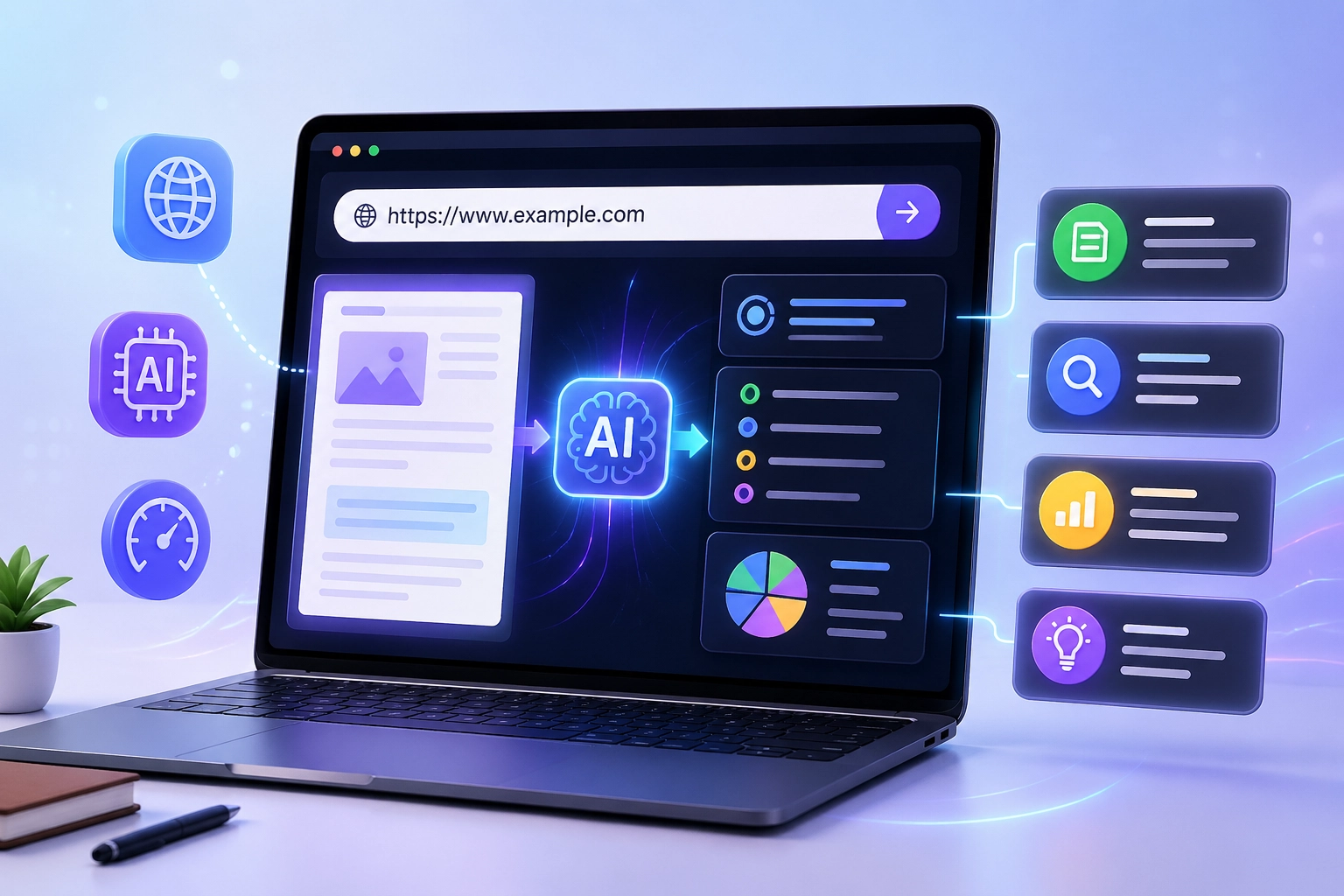
In today's fast-paced digital landscape, content teams and SEO professionals face a constant challenge: understanding high-performing web pages quickly without spending hours reading every detail. A single competitor article or landing page can contain thousands of words, complex structures, and subtle strategies that influence rankings and engagement.
AI-powered website content analysis solves this problem. By simply pasting a URL, marketers can now extract clean summaries, identify key themes, evaluate tone and structure, uncover SEO opportunities, and receive actionable recommendations all in seconds rather than minutes.
As we move through 2026, the integration of generative AI into content workflows has become standard. Reports show that 80-94% of marketers actively use AI for content-related tasks, with many saving 6-13 hours per week on research and analysis. This efficiency gain allows teams to produce 42% more content monthly while maintaining higher quality standards.
This comprehensive guide provides a clear, step-by-step framework for analyzing any website content using AI. You will learn proven methods, recommended tools including accessible options suitable for individuals and small teams, powerful prompt techniques, and practical applications that deliver real results in competitive niches.
Why Website Content Analysis Matters in 2026
Content marketing success now depends on speed and precision. Traditional manual review limits how many pages teams can evaluate, creating bottlenecks in research and strategy development.
AI analysis delivers several key advantages:
-
Significant time savings: Marketers report saving an average of 6.1 hours weekly, with content specialists often gaining 7-8 hours through automated summarization and insight generation.
-
Deeper competitor intelligence: Quickly reveal what makes top-ranking pages effective heading structures, content depth, keyword usage, and engagement elements.
-
Content gap identification: Spot missing topics, angles, or data that competitors cover, helping you create more comprehensive pieces.
-
Improved quality and optimization: Assess readability, tone consistency, AI-readiness for generative search engines, and overall persuasiveness.
-
Scalable research: Analyze multiple URLs efficiently for large audits or campaign planning.
-
Better ROI: Teams using AI report stronger content performance and higher returns on marketing efforts.
Common applications include preparing content briefs from SERP leaders, auditing your own published pages for improvements, and evaluating landing pages for conversion potential. In an era where AI search engines like Perplexity and ChatGPT influence discovery, understanding how content performs in both traditional and generative contexts has become essential.
Understanding How AI Processes Website Content
Modern AI tools follow a structured workflow when analyzing a URL:
-
Content Retrieval: The system fetches the page and extracts primary text while filtering out navigation, advertisements, footers, and other non-essential elements.
-
Text Processing: Natural Language Processing (NLP) breaks the content into sentences, paragraphs, and semantic units. Large Language Models (LLMs) then identify entities, topics, and relationships.
-
Insight Generation: The AI evaluates multiple dimensions — summary creation, sentiment and tone detection, keyword extraction, structure mapping, readability scoring, and gap analysis.
-
Recommendation Engine: Advanced outputs include specific suggestions for enhancement, such as adding statistics, improving flow, or targeting additional search intents.
Important considerations:
-
Performance varies with site complexity. JavaScript-heavy or heavily dynamic pages may require specialized extraction tools.
-
Always review robots.txt and respect site terms to ensure ethical usage.
-
AI outputs provide strong starting points but benefit from human expertise for final interpretation and strategy application.
Free tools often focus on core summarization, while dedicated platforms add layers like SEO scoring and batch processing.
Top AI Tools for URL-Based Content Analysis in 2026
|
Tool |
Key Strengths |
Pricing |
Best Suited For |
|
ITS AI Tools – AI Web Chat |
Direct URL pasting for webpage content analysis; part of a larger suite with 163+ features including summarization, keyword extraction, content rewriting, and plagiarism checking. Simple interface with multilingual support. |
Free plan available (with model credits); Premium from $9.99/month |
Everyday users, small teams, and beginners seeking quick, no-code analysis without steep learning curves. |
|
Frase.io |
Content briefs, competitor research, and optimization focused on both SEO and generative engine visibility. |
Paid plans with trials |
SEO professionals creating data-backed outlines. |
|
Surfer SEO |
Real-time content scoring, SERP analysis, and optimization recommendations. |
Paid |
Teams optimizing for search performance. |
|
Perplexity / Claude / ChatGPT (browsing enabled) |
Flexible deep analysis through custom prompts; excellent for nuanced insights. |
Free tiers + paid |
Users wanting customizable, detailed reports. |
|
Semrush AI Tools |
Broader SEO suite with visibility tracking and content auditing capabilities. |
Paid |
Agencies handling multiple clients. |
For most practical daily workflows, ITS AI Tools' AI Web Chat offers an excellent balance of simplicity and capability. Users register at ai.it-s.com, access the free plan, and directly input URLs to receive content analysis. The platform also includes complementary tools like Summarize Text, Keyword Extractor, and AI Content Detector, making it a versatile hub for content teams.
Step-by-Step Guide to Analyzing Website Content with AI
Approach 1: Dedicated Tool Method (Fastest for Quick Insights)
-
Visit https://ai.it-s.com/ and log in (free registration available).
-
Open the AI Web Chat feature.
-
Paste the complete URL of the target webpage.
-
Submit the request and review the generated output, which typically includes a summary and extracted insights.
-
Follow up within the chat for additional details, such as tone evaluation or improvement suggestions.
This method works well for rapid scans and fits seamlessly into busy schedules.
Approach 2: LLM-Powered Analysis with Structured Prompts (Highest Depth)
Use Claude, ChatGPT, or Perplexity with browsing capabilities. Apply this detailed prompt template for consistent, professional results:
text
Act as an experienced content strategist and SEO analyst. Analyze the webpage at this URL: [PASTE FULL URL HERE]
Deliver a structured report covering:
1. TL;DR Summary (2-4 sentences capturing the core message)
2. Key Takeaways (5-8 bullet points)
3. Content Structure (heading hierarchy, use of lists/tables, estimated readability)
4. Tone and Sentiment (overall voice, emotional appeal, authority level)
5. Primary Topics and Keywords (main themes plus high-value terms)
6. Strengths (elements that contribute to performance)
7. Weaknesses and Content Gaps (areas for potential improvement)
8. Actionable Recommendations (5-7 specific, prioritized ideas)
9. SEO and Generative Engine Optimization Opportunities (suggestions for better visibility in AI search)
Base your analysis on current 2026 best practices. Remain objective and constructive.
Paste the URL and run the prompt. For even better results, first extract clean text using a dedicated tool, then feed it into the LLM.
Approach 3: Hybrid Workflow
Combine both methods:
-
Start with ITS AI Web Chat or a clean extractor for fast output.
-
Refine and expand insights using the structured LLM prompt.
-
Compare results across 2-3 competing URLs to map industry patterns.
Document findings in a consistent template for easy team sharing and tracking
Real-World Applications and Examples
Competitor Research: Analyze the top 5 ranking pages for a target keyword. Identify shared structures (such as frequent use of numbered lists or data-backed sections) and unique angles you can expand upon.
Self-Audit for Improvement: Run your published articles through the process. Common findings include opportunities to enhance subheadings, add recent statistics, or strengthen calls-to-action.
Content Brief Creation: Use insights from multiple URLs to build comprehensive outlines that address gaps and align with searcher intent.
Example Outcome: When analyzing a well-ranked marketing guide, the AI might highlight strong use of practical examples and clear sections, while noting the absence of 2026-specific tool updates or visual aids. This information directly informs a stronger competing piece.
Larger teams can extend this to batch analysis for quarterly audits or campaign planning.
Best Practices, Advanced Prompts, and Pitfalls to Avoid
Effective Practices:
-
Cross-verify AI findings with manual review and current data.
-
Maintain ethical standards by focusing on inspiration and improvement rather than direct copying.
-
Integrate analysis into existing workflows (e.g., before drafting new content).
-
Track results over time to measure how applied insights affect performance metrics.
Advanced Prompt Variations:
-
"Score this content on a 1-10 scale for generative search readiness and list specific fixes."
-
"Compare this page against [second URL] and highlight unique value propositions."
-
"Extract all claims and statistics for verification, then suggest supporting sources."
Common Mistakes:
-
Relying solely on surface-level summaries without requesting recommendations.
-
Neglecting readability or mobile experience factors.
-
Failing to act on insights analysis delivers value only when translated into better content.
The Evolution of AI Content Analysis
In the coming years, AI agents will likely handle full-site crawls, automated comparisons across dozens of pages, and integrated strategy suggestions. Multimodal capabilities analyzing text alongside images and video and tighter connections to AI visibility tracking tools will further enhance the process.
Platforms emphasizing accessibility, such as all-in-one solutions with generous free tiers, will continue to democratize these capabilities for smaller teams and individual creators.
Final Thoughts
Analyzing website content with AI by simply pasting a URL has become an essential capability for content professionals in 2026. With 93% of marketers already leveraging AI to accelerate content processes and teams producing significantly more output while saving hours each week, the ability to rapidly extract insights from any webpage provides a clear competitive advantage.
The methods outlined from dedicated tools like ITS AI Tools’ AI Web Chat to structured prompts in leading LLMs enable efficient competitor research, precise self-audits, and informed content strategies that align with both traditional SEO and generative engine optimization demands.