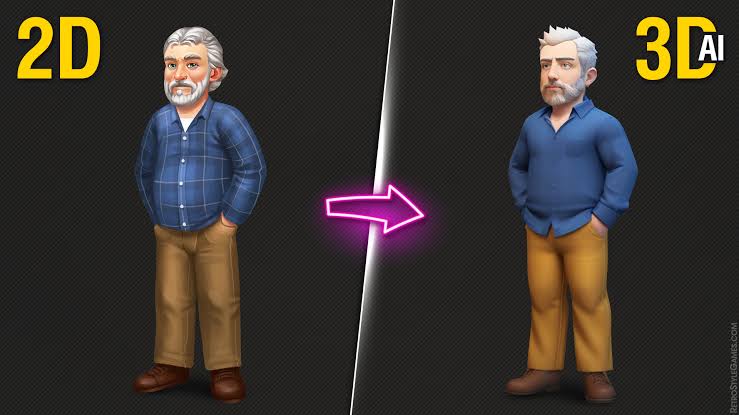
Creating a 3D model once required advanced skills, expensive software, and hours of manual work. Today, AI has made the process much faster by turning images into 3D models in just a few minutes.
The answer depends on factors like image quality, object complexity, and the AI technology being used. While AI can create realistic models with impressive detail, it still has limitations, especially when precision is required.
In this guide, we'll explain how AI creates 3D models from images, how accurate these models really are, what affects their quality, and where they work best.
How Does AI Convert Images Into 3D Models?
AI can now transform a simple 2D image into a three-dimensional model, but the process behind it involves several advanced technologies working together. An AI image-to-3D model generator uses computer vision, machine learning, and 3D reconstruction techniques to understand an image and create a digital representation of the object.
Unlike traditional 3D scanning, AI does not capture every angle of an object physically. Instead, it analyzes the visual information available in an image and predicts the missing details, such as depth, shape, and hidden surfaces. This ability allows AI to create 3D models quickly, but it also explains why accuracy can vary between different objects.
The image-to-3D conversion process usually happens in four main stages:
1. AI Analyzes the Image and Understands the Object
The first step begins when AI examines the uploaded image. Using computer vision algorithms, the system identifies the important visual information needed to recreate the object.
AI analyzes:
-
Object shape and boundaries
-
Colors and textures
-
Surface details
-
Lighting and shadows
-
Background elements
During this stage, AI tries to understand what the object is and separate it from unnecessary visual information. For example, when you upload a product image, the AI identifies the product itself instead of including the surrounding background.
This process relies on technologies such as image recognition, object detection, and visual data analysis.
2. AI Predicts Depth and Creates a 3D Structure
After understanding the image, AI estimates the object's three-dimensional structure. Since a normal image only provides a flat 2D view, the system must predict information that is not directly visible.
AI estimates:
-
Object depth
-
Volume and dimensions
-
Hidden areas
-
Overall geometry
This stage is one of the biggest challenges in AI 3D reconstruction. The system does not actually see the hidden side of an object; instead, it uses patterns learned from previous data to predict what those areas might look like.
For example, a front image of a shoe shows its design and colors, but AI must estimate the sole, back portion, and unseen details.
3. AI Generates the 3D Mesh and Applies Textures
Once AI understands the object's structure, it creates the actual 3D model. The system generates a 3D mesh, which defines the shape and surface of the object using connected polygons.
After creating the geometry, AI adds realistic details through texture mapping. This process applies:
-
Colors
-
Materials
-
Surface patterns
-
Visual details
-
Realistic finishes
The result is a digital asset that can be viewed, edited, or used in different creative workflows.
Common output formats include:
-
OBJ
-
FBX
-
GLB
-
STL
4. Refinement and Preparing the 3D Model for Use
The final stage involves improving and preparing the AI-generated 3D model for its intended purpose. Some models may work immediately, while others need additional editing to improve geometry, textures, or accuracy.
Creators often refine models for:
-
Animation
-
Gaming assets
-
Ecommerce visualization
-
3D printing
-
Digital experiences
The level of refinement depends on how precise the final model needs to be.
Why Understanding the AI 3D Generation Process Matters
Understanding how AI converts images into 3D models helps explain why some results look highly realistic while others need improvement. AI has made 3D model generation from images faster and more accessible, but factors like image quality, object complexity, and available visual information still influence the final result.
How Accurate Are AI-Generated 3D Models From Images?
AI-generated 3D models from images can achieve impressive accuracy for visual applications, but they are not always exact digital copies of real-world objects. Their accuracy depends on several factors, including image quality, object complexity, AI model capability, and the purpose of the final 3D model.
For creative projects, ecommerce visualization, and digital experiences, AI can create realistic 3D assets quickly. However, applications that require exact measurements, engineering precision, or manufacturing standards may still require human review and refinement.
In professional workflows, experts do not judge an AI-generated 3D model only by how realistic it looks. They evaluate whether the model has the right structure, quality, and usability for its intended purpose.
The accuracy of an AI-generated 3D model is mainly measured through three key areas:
-
Visual accuracy
-
Geometric accuracy
-
Practical usability
Visual Accuracy: How Realistic Does the 3D Model Look?
Visual accuracy measures how closely an AI-generated model matches the appearance of the original image.
AI can often recreate:
-
Overall shape
-
Colors
-
Surface appearance
-
Materials
-
Visible design features
This makes AI-generated 3D models highly useful for applications where realistic presentation matters, such as:
-
Product visualization
-
Ecommerce experiences
-
Digital marketing assets
-
Virtual demonstrations
However, a model that looks realistic does not always mean that every structural detail matches the original object.
Geometric Accuracy: Does the Model Match the Real Object Structure?
Geometric accuracy focuses on how correctly AI recreates the actual structure and proportions of an object.
Experts evaluate factors such as:
-
Shape consistency
-
Object dimensions
-
Surface curves
-
Structural details
-
Mesh quality
A model may appear visually accurate but still contain differences in its underlying geometry. This becomes important when users need to edit, animate, manufacture, or physically reproduce the model.
Geometric accuracy matters most for:
-
3D printing
-
Product development
-
CAD workflows
-
Industrial design
Practical Accuracy: Can the AI 3D Model Be Used Effectively?
The usefulness of an AI-generated 3D model depends on the final goal. A model created for an online product preview does not require the same level of precision as a model used for engineering or manufacturing.
A general accuracy comparison:
|
Application |
Expected Accuracy |
|
Marketing visuals |
High visual accuracy |
|
Ecommerce visualization |
High |
|
Gaming assets |
Medium to High |
|
Animation workflows |
Medium |
|
Engineering and manufacturing |
Requires verification |
What Factors Influence AI-Generated 3D Model Accuracy?
The accuracy of an AI-generated 3D model depends on several technical and visual factors. While modern AI models can produce highly realistic results, the final quality varies based on the input data, reconstruction method, and the AI technology used. Understanding these factors helps set realistic expectations and improve the quality of generated models.
Image Quality and Reference Information
The quality of the source images has the greatest impact on the final 3D model. AI can reconstruct objects more accurately when images are sharp, well-lit, and capture important surface details.
Better results usually come from:
-
High-resolution images
-
Clear object visibility
-
Multiple reference angles
-
Consistent lighting
-
Minimal background distractions
Providing multiple images instead of a single photo allows AI to better estimate depth, reconstruct hidden surfaces, and generate more accurate geometry. This approach, known as multi-view reconstruction, generally produces more reliable results than single-image generation.
AI Model Capability
Not all AI image-to-3D generators use the same technology. Some models are optimized for speed, while others prioritize realistic geometry, textures, or production-ready assets.
Modern AI systems may combine technologies such as:
-
Computer vision
-
Machine learning and deep learning
-
Neural Radiance Fields (NeRF)
-
Gaussian Splatting
-
Diffusion models
-
Depth estimation
-
3D reconstruction algorithms
These technologies help AI understand an object's shape, estimate missing details, and generate realistic 3D meshes from one or more images.
Object Complexity
Simple objects with clear shapes are generally easier for AI to reconstruct than highly detailed or reflective objects.
Accuracy may decrease when working with:
-
Transparent or glass objects
-
Reflective or metallic surfaces
-
Thin structures and fine details
-
Organic shapes such as human faces or hands
-
Objects with hidden or occluded areas
Complex geometry often requires additional manual refinement to achieve production-ready results.
Post-Processing and Mesh Optimization
The initial AI-generated model is often only the starting point. Professional workflows typically include post-processing to improve mesh quality, textures, and overall usability.
Common refinement steps include:
-
Mesh optimization
-
Topology cleanup
-
Texture enhancement
-
UV mapping
-
Geometry correction
These improvements make the model better suited for animation, gaming, 3D printing, CAD, or other professional applications.
How Reliable Are AI-Generated 3D Models Today?
AI-generated 3D models have become powerful tools for accelerating digital creation, but they are not a complete replacement for traditional 3D modeling in every situation.
Today, AI works best as a productivity tool that helps creators:
-
Generate concepts faster
-
Create digital assets efficiently
-
Explore new design possibilities
-
Reduce manual modeling time
For visual and creative applications, AI can deliver impressive results. For precision-focused industries, combining AI generation with professional review remains the most reliable approach.
How AI-Generated 3D Models Improve the Creation Process
Instead of manually building every element, AI tools can create a starting model from images within a short time. This helps users quickly explore ideas, test concepts, and generate digital assets without advanced 3D modeling experience.
AI-powered 3D generation is especially useful for:
-
Concept development
-
Product visualization
-
Creative experimentation
-
Rapid prototyping
-
Early design stages
However, AI-generated models may still require manual refinement when projects demand:
-
Exact dimensions
-
Clean topology
-
Professional animation readiness
-
Engineering-level precision
AI 3D Modeling vs Traditional 3D Modeling: Accuracy Comparison
|
Feature |
AI-Generated 3D Models |
Traditional 3D Modeling |
|
Creation speed |
Very fast |
Time-intensive |
|
Accuracy control |
Moderate |
Very high |
|
Human involvement |
Less during creation |
Required throughout process |
|
Editing flexibility |
May require cleanup |
Full control |
|
Best for |
Concepts, visualization, prototypes |
Professional production |
|
Technical precision |
Limited in complex projects |
Excellent |
When Should You Choose AI-Generated 3D Models?
AI-generated 3D models are a strong choice when speed and visual quality matter more than perfect technical accuracy.
They work well for:
-
Marketing visuals
-
Ecommerce product experiences
-
Creative projects
-
Design inspiration
-
Early prototypes
For example, a brand creating a virtual product showcase may benefit from AI-generated assets because the focus is customer experience rather than manufacturing precision.
When Should You Choose Traditional 3D Modeling?
Traditional 3D modeling remains the better option when accuracy directly affects functionality.
It is preferred for:
-
Industrial design
-
Mechanical parts
-
Architecture
-
Engineering simulations
-
Production-ready assets
These fields require detailed control over:
-
Measurements
-
Materials
-
Geometry
-
Performance requirements
Can AI Replace Traditional 3D Artists?
AI is unlikely to completely replace traditional 3D modeling. Instead, it is becoming a powerful assistant that helps artists and designers work faster.
Modern workflows often combine both approaches:
AI helps with:
-
Idea generation
-
First drafts
-
Concept models
-
Faster asset creation
Human experts handle:
-
Precision adjustments
-
Final optimization
-
Creative decisions
-
Professional quality control
The future of 3D creation will likely involve collaboration between AI tools and human expertise rather than replacing one with the other.
Where Are AI-Generated 3D Models Used in Real-World Applications?
AI-generated 3D models have become part of professional workflows across multiple industries. Most businesses don't publish AI-generated models without review. Instead, designers use AI to create an initial model, then refine its geometry, textures, and proportions before using it in customer-facing products or production environments.
Ecommerce and Product Visualization
Many ecommerce brands create AI-generated 3D models before a product launch, when physical samples are not yet available. For example, a furniture company can generate a 3D model of a new sofa for its website and AR shopping experience weeks before manufacturing begins. Once the final product is ready, designers update the model to match the finished materials, colors, and dimensions.
Gaming and Entertainment
Game studios often use AI during the concept stage rather than in the final production pipeline. For example, environment artists can generate castle ruins, rocks, or medieval props with AI to explore different design ideas. After selecting a concept, artists rebuild or optimize the asset in Blender, Maya, or Unreal Engine to meet performance and quality standards.
Architecture and Interior Design
Architects use AI-generated 3D models to communicate design ideas before creating detailed construction drawings. For example, an interior designer can generate several kitchen layouts in minutes, helping clients compare styles and approve a concept before investing time in detailed CAD modeling.
Marketing and Advertising
Creative agencies use AI-generated 3D assets to produce marketing visuals before product photography is available. For example, a smartwatch brand can launch promotional banners and social media campaigns using AI-generated renders while the physical product is still in manufacturing, allowing marketing activities to begin earlier.
Education and Training
Universities and training organizations use AI-generated 3D models to make technical subjects easier to understand. For example, medical students can examine a rotating 3D heart model to study chambers, valves, and blood flow from different angles instead of relying only on textbook illustrations.
Product Development and Prototyping
Product design teams use AI-generated 3D models to evaluate concepts before building physical prototypes. For example, an electronics manufacturer can compare several smart speaker designs digitally, gather stakeholder feedback, and identify design improvements before investing in tooling or production.
How Can You Improve the Accuracy of AI-Generated 3D Models?
Improving the accuracy of an AI-generated 3D model starts with providing better inputs and choosing the right workflow. While AI technology continues to improve, users can achieve better results by following a few practical steps.
Use High-Quality Reference Images
Clear and detailed images help AI understand the object more effectively. Use images with:
-
Good lighting
-
Clear object visibility
-
Multiple viewpoints
-
Minimal distractions
Provide More Visual Information
When possible, use multiple images instead of a single reference. Additional views help AI create a more complete representation of the object and reduce missing details.
Choose the Right AI 3D Tool
Different AI 3D generators are designed for different purposes. Select a tool based on your requirements, such as:
-
Product visualization
-
Gaming assets
-
Creative design
-
Professional workflows
Refine the Output When Needed
For high-quality results, review and improve the generated model using traditional 3D software. Small adjustments can improve the final appearance and usability.
Use Multiple Images Instead of One
While many AI tools can generate a 3D model from a single image, professionals often use multiple reference images to achieve better results. Each additional angle provides visual information that a single photo cannot capture, such as hidden surfaces, object depth, and side profiles. This reduces the amount of guesswork the AI must perform when reconstructing the model.
For example, a front-facing image of a chair shows its overall shape but does not reveal the backrest, rear legs, or underside. By providing images from the front, back, sides, and top, the AI can reconstruct a more complete and geometrically accurate model. This multi-view reconstruction approach is widely used because it produces cleaner meshes, preserves object proportions, and reduces missing or distorted details.
What Is the Future of AI-Generated 3D Models?
AI-generated 3D models are becoming more practical as advances in computer vision, generative AI, and 3D reconstruction improve both speed and quality. Instead of replacing professional artists and designers, these technologies are helping teams automate repetitive tasks, accelerate concept development, and shorten production timelines. As AI continues to evolve, businesses will likely integrate it into existing 3D workflows rather than treat it as a complete replacement for traditional modeling.
Real-Time 3D Generation
Several AI platforms can already generate draft 3D models within seconds. As reconstruction algorithms continue to improve, designers and product teams will spend less time creating initial models and more time refining details. Faster generation will support rapid prototyping, product visualization, and creative brainstorming without eliminating the need for professional review.
Text and Image to 3D
The next generation of AI tools is moving beyond image-to-3D conversion by combining text prompts with reference images. Instead of relying on a single photo, users will describe an object, upload multiple images, and generate editable 3D assets with greater control over shape, materials, and style. This approach will improve creative flexibility while reducing manual modeling during the concept stage.
Spatial AI and Better Scene Understanding
Spatial AI enables systems to understand depth, object relationships, and three-dimensional space more accurately. These improvements will help AI reconstruct complete environments instead of individual objects, supporting applications such as digital twins, robotics, indoor mapping, and immersive virtual experiences.
AI-Powered Game Asset Creation
Many game studios already use AI during pre-production to generate environment props, background assets, and early character concepts. Artists then optimize polygon counts, improve UV mapping, refine textures, and prepare the assets for game engines such as Unreal Engine or Unity. Future AI models are expected to automate more of these preparation tasks while allowing artists to maintain creative control over the final result.
AR and VR Integration
As augmented reality (AR) and virtual reality (VR) continue to expand, businesses will require larger volumes of high-quality 3D content. Retailers can create virtual product showrooms, manufacturers can develop interactive training simulations, and educational institutions can build immersive learning environments. AI-generated 3D models will help reduce content creation time while professionals continue to validate accuracy and optimize performance for different devices.
AI Will Support Human Creativity, Not Replace It
Professional designers, engineers, and 3D artists already use AI as a productivity tool rather than a replacement for human expertise. AI accelerates concept generation and repetitive modeling tasks, while professionals make creative decisions, verify geometry, improve topology, and ensure production-ready quality. As AI technology advances, this collaborative workflow will likely remain the industry standard for creating accurate and high-quality 3D models.
Best AI Tools for Creating 3D Models From Images
Create AI-generated 3D models from images, several tools offer reliable results for different use cases. Some of the most popular options include:
-
Meshy AI : Ideal for quickly generating high-quality 3D models from text prompts or images, making it a popular choice for game developers and designers.
-
Tripo AI : Known for its fast image-to-3D conversion with detailed textures, making it suitable for product visualization and creative projects.
-
Luma AII : Uses advanced AI technology to create realistic 3D assets from images and videos, making it a strong option for immersive digital experiences.
-
Hunyuan3D I : An open-source AI model designed for generating detailed 3D objects, offering flexibility for developers and researchers.
-
Rodin AI I : Focuses on producing production-ready 3D assets with clean geometry for gaming, animation, and digital content creation.
-
ITS AI I : While ITS AI is not a dedicated image-to-3D generator, it helps businesses and creators streamline AI-powered workflows, including content creation, brainstorming, and creative project management alongside emerging 3D technologies.
Conclusion:
AI-generated 3D models from images have made 3D content creation faster, more accessible, and more efficient across industries like ecommerce, gaming, architecture, and product design. While modern AI tools can produce impressive visual results, their accuracy still depends on factors such as image quality, object complexity, and the intended use of the model.
For creative projects and rapid prototyping, AI offers an excellent starting point. However, applications that require precise measurements or production-ready assets still benefit from human review and refinement. As technologies like multi-view reconstruction, Spatial AI, and text-to-3D continue to evolve, AI will become an even more valuable tool for accelerating professional 3D workflows rather than replacing human expertise.