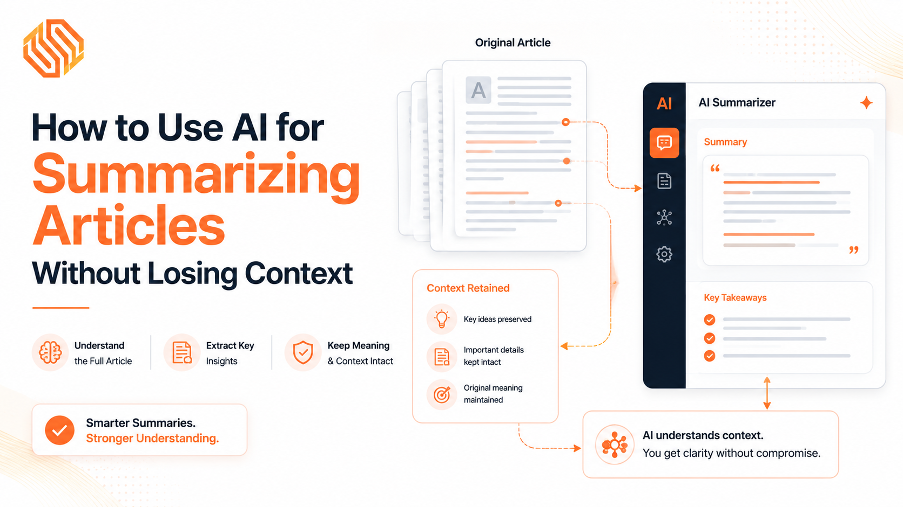
You asked AI to summarize an article. It gave you something back in seconds. But when you read it something felt off. A key argument was missing. The author's actual point was lost. The summary was shorter, yes but it wasn't right.This is not an AI problem. This is a prompting and guidance problem.
AI can process a 5,000-word article faster than you can scroll through it but preserving context is not automatic. If you are also exploring how AI can handle other content tasks beyond summarization, our guide on how to write a blog post with AI in 10 minutes covers the full content creation workflow from start to finish. Context is something you must intentionally build into the process. Without the right instructions, even the best AI summarizer will strip away nuance, flatten arguments, and miss the deeper meaning behind the words.
In this guide, you will learn exactly how to use AI for summarizing articles without losing context from understanding why context gets lost in the first place, to writing prompts that force AI to preserve meaing, structure, and intent every single time.
Whether you are summarizing long articles for research, work, or content creation by the end of this guide, you will have a repeatable system that gives you fast summaries you can actually trust.
Why AI Summaries Lose Context (The Real Problem)
Most people assume a bad AI summary means a bad AI tool. The reality is different. The tool is rarely the problem the process is.
Context loss happens before the AI even starts summarizing. It happens when the intent is unclear, when the input is unstructured, and when the AI is given no direction on what actually matters in the article.
Understanding why context disappears is the first step to making sure it never does.
What "Context" Actually Means in Summarization
Context is not just the words in an article. It is the relationship between ideas why an argument was made, what evidence supports it, and what conclusion it leads to.
When AI summarizes without context guidance, it does one of two things:
-
It picks the most statistically prominent sentences which are not always the most meaningful ones
-
It rewrites content in generalized language which removes the specificity that made the original valuable
A summary without context is not a shorter version of the article. It is a different article one that may carry a completely different meaning.
5 Reasons AI Drops Important Information
Understanding these five reasons will immediately change how you use any AI summarization tool:
1. No Intent Was Defined: AI does not know why you need the summary. A summary for a student, a marketing professional, and a researcher should look completely different but without instructions, AI produces one generic version for everyone.
2. The Prompt Was Too Vague: Commands like "summarize this" or "make this shorter" give AI zero direction. The AI fills the gap with assumptions and those assumptions are almost always wrong for your specific use case.
3. The Article Was Too Long for One Pass: When a long article is fed into AI as a single block, the model begins deprioritizing content from the middle sections. Important arguments buried in the body of the article get compressed or dropped entirely.
4. No Structure Was Preserved: Articles follow a logical flow introduction, argument, evidence, conclusion. When AI ignores this structure and summarizes everything as flat text, the cause-and-effect relationships that give the article its meaning disappear.
5. AI Optimizes for Brevity, Not Accuracy: By default, AI summaries are trained to shorten content. Brevity is the goal, not faithfulness to the original message. Unless you explicitly tell it otherwise, the AI will always choose shorter over more accurate.
Extractive vs. Abstractive Which One Loses Context Faster?
There are two ways AI summarizes content and each one loses context differently.
Extractive Summarization: Pulls sentences directly from the original text. It is more accurate because the words are unchanged but it often misses the bigger picture. Individual sentences taken out of their surrounding paragraphs can lose their meaning entirely.
Abstractive Summarization: Rewrites the content in new words similar to how a human would summarize. This produces more natural, readable summaries but introduces a higher risk of misinterpretation. The AI is not just selecting, it is generating. And generation without guidance leads to hallucination, oversimplification, and tonal shifts.
Which one should you use?
The answer is not one or the other, it is knowing when to use which, and instructing your AI accordingly.
How AI Summarization Actually Works
Most people treat AI summarization like a black box: paste the article, get the summary, move on. But when you understand what is actually happening inside the model, you stop making the mistakes that cause context loss in the first place.
You do not need to be a machine learning engineer to understand this. You just need to know enough to guide the process correctly.
How LLMs Read and Process an Article
When you paste an article into an AI summarizer, the model does not read it the way you do top to bottom, sentence by sentence, building understanding as it goes.
Instead, it breaks the entire text into tokens small units of words or characters and analyzes the statistical relationships between them across the entire input at once.
This means a few critical things for summarization:
-
AI does not inherently know which section is more important than another
-
It cannot feel the weight of an argument the way a human reader can
-
It assigns importance based on pattern frequency words and phrases that appear more often are treated as more significant
This is exactly why a well-written article with a single powerful conclusion buried at the end often gets ignored in AI summaries. The conclusion appeared once. The introductory points appeared everywhere. The AI chose frequency over meaning.
The fix? You tell it what is important before it starts.
What Happens Inside AI When It Summarizes
Here is a simplified but accurate picture of what the model does the moment you hit summarize:
Step 1 Tokenization: The article is broken into tokens. A 1,000-word article becomes roughly 1,300 to 1,500 tokens depending on the language and structure.
Step 2 Attention Scoring: The model uses an internal mechanism called attention to decide which tokens relate strongly to each other. High-attention connections signal importance; these are the parts most likely to appear in the summary.
Step 3 Compression: Based on attention scores, the model selects or generates content that represents the highest-scored relationships. Everything with a lower attention score gets dropped including nuance, supporting evidence, and subtle arguments.
Step 4 Output Generation: The model produces the final summary based on what survived the compression step. If your prompt gives no direction, the output reflects the model's default priorities, not yours.
The entire process happens in seconds. But every step is a potential point of context loss and every step can be influenced by how you prompt.
How LLMs Understand and Misunderstand Meaning
Here is something most AI summarization guides will never tell you:
LLMs do not understand the meaning. They predict it.
When Claude, ChatGPT, or any other large language model summarizes your article, it is not comprehending the author's intent the way a human editor would. It is generating the most statistically probable response based on:
-
The patterns it learned during training
-
The signals you gave it in the prompt
-
The structure and language of the article itself
This is why two different prompts on the same article can produce completely different summaries neither wrong in isolation, but potentially very different from what the author actually meant.
This probabilistic nature of LLMs is not a flaw, it is simply how they work. And once you accept it, you stop expecting AI to automatically understand context and start deliberately providing it.The same prediction-based processing that powers summarization also drives other AI content tools including the AI chatbot systems that businesses use for customer support and retention, where context accuracy is equally critical.
Common Limitations You Must Know Before Summarizing
Even the most advanced AI summarizers share these fundamental limitations. Knowing them protects you from over-trusting the output:
1. Middle Section Blindness:In very long articles, AI tends to pay more attention to the beginning and end of the input. Important content in the middle supporting arguments, data, examples is frequently underweighted or dropped.
Fix: Break long articles into sections and summarize each one separately.
2. Domain-Specific Language Loss: Technical, legal, or academic content uses specialized terminology where precision matters. AI will often substitute familiar general language for domain-specific terms changing the meaning in the process.
Fix: Instruct AI to preserve key terminology and avoid simplifying technical language.
3. Opinion and Tone Flattening: When an article takes a clear stance analytical, critical, persuasive AI often neutralizes it. The summary reads as factual even when the original was deliberately opinionated.
Fix: Tell AI to preserve the author's tone and perspective explicitly in your prompt.
4. Implied Meaning Blindness: Skilled writers often communicate meaning between the lines through examples, analogies, and deliberate structure. AI almost never captures implied meaning unless directly instructed to look for it.
Fix: Ask AI to identify not just what the article says, but what the author is trying to communicate.
5. Single-Pass Limitation: Feeding a long article to AI in one go forces the model to make aggressive compression decisions across the entire text at once. The longer the article, the more context gets sacrificed.
Fix: Summarize section by section, then ask AI to synthesize the section summaries into a final overview.
How to Use AI for Summarizing Articles Without Losing Context (Step-by-Step)
Knowing why context gets lost is half the battle. The other half is having a repeatable system that prevents it from happening every single time.
The six steps below are not theoretical; they are a practical workflow you can apply immediately to any article, any AI tool, and any summarization goal.
Step 1: Define Your Summary Intent Before You Paste Anything
Before you open your AI tool, answer one question:
"What do I need this summary to do?"
This single question changes everything. Because a summary written for a researcher looks nothing like one written for a busy executive and AI has no way of knowing the difference unless you tell it.
Here is how intent shapes the summary.
How to apply this: Before prompting, write one sentence that defines your intent:
"I need a summary of this article that highlights the main argument and key supporting evidence written for a non-technical reader."
That one sentence alone will produce a dramatically better summary than clicking summarize with no context.
Step 2 : Scan the Article Structure Before Feeding It to AI
AI summarizes what you give it but you control what you give it and how.
Before pasting an article, spend 60 seconds scanning it for:
-
How many sections does it have? Long articles with 6+ sections should be summarized section by section not all at once
-
Where is the main argument? Introduction, middle, or conclusion? Flag it mentally so you can verify AI captured it
-
Are there data points or statistics? These are high-risk for being dropped or misrepresented note them before summarizing
-
What is the author's tone? Neutral, critical, persuasive? You will need to tell AI to preserve it
This 60-second scan gives you a reference point to verify the AI output against and it takes less time than re-reading a bad summary three times trying to figure out what went wrong.
Step 3: Write a Context-Preserving Prompt (Not Just "Summarize This")
This is where most people lose context and where you will gain the biggest advantage.
A weak prompt produces a weak summary. Every time.Prompt quality matters across every AI use case, not just summarization. If you work with visual content, the same principle applies when using AI image prompt templates for ads and social media posts where vague prompts produce generic, unusable outputs.
Weak prompt:
"Summarize this article."
What AI does: Picks the most frequent phrases, compresses aggressively, ignores tone and intent, produces a generic output.
Strong prompt:
"Summarize this article in 200 words. Preserve the author's main argument, the key supporting evidence, and the conclusion. Maintain a neutral tone. Do not oversimplify technical terms. Write for a professional audience."
What AI does: Follows specific instructions, prioritizes the right content, preserves meaning, produces a usable output.
Here is a Context-Preserving Prompt Formula you can reuse every time:
Summarize this [article type] in [word count or length].
Preserve: [main argument / key findings / author's stance / structure]
Tone: [neutral / analytical / persuasive / technical]
Audience: [who will read this summary]
Do not: [oversimplify / remove examples / change terminology]
Example using the formula:
"Summarize this research paper in 250 words. Preserve the research objective, methodology, key findings, and limitations. Maintaining technical accuracy does not simplify domain-specific terms. Write for an academic audience. Do not remove statistical results."
The more specific your instructions, the less room AI has to make bad decisions on your behalf.
Step 4: Control Summary Length Without Destroying Meaning
Length is one of the most overlooked causes of context loss.
Here is the problem: the shorter you make a summary, the more the AI has to decide what to cut. And AI's cutting decisions are based on pattern frequency not on what actually matters to you.
The safe compression ratios:
Going below these thresholds does not produce a tighter summary, it produces an incomplete one.
If you genuinely need an ultra-short summary a 3-sentence overview for example do it in two steps:
Step A: Ask AI for a full summary using the safe compression ratio above Step B: Ask AI to condense that summary into 3 sentences
This two-step approach forces AI to make compression decisions on already-summarized content where there is far less nuance to lose.
Step 5 : Summarize Long Articles Section by Section
This is the single most effective technique for preserving context in long articles and almost nobody does it.
When you feed a 4,000-word article into AI as one block, the model is forced to make aggressive trade-offs across the entire text simultaneously. Middle sections get deprioritized. Supporting evidence gets dropped. The output feels like a summary of the introduction and conclusion only because that is largely what it is.
The section-by-section method:
Round 1: Copy and paste each major section separately. Ask AI to summarize each section in 3 to 5 sentences.
Round 2: Take all the section summaries and paste them together. Ask AI to synthesize them into one cohesive final summary.
Round 3: Read the final summary against your original 60-second scan from Step 2. Verify the main argument is there. Verify the key data points survived. Verify the tone is correct.
This three-round approach takes an extra 3 to 5 minutes but it produces summaries that are genuinely faithful to the original article, not just a compressed version of its most obvious points.
Step 6 : Run a Human Review Pass Before Using the Summary
AI handles the speed. You handle the accuracy.
No matter how good your prompt is, a quick human review pass is non-negotiable, especially when the summary will be used for research, decision-making, or content creation.
Your 3-point review checklist:
Check 1: Is the main argument present and accurate? Read the first and last sentence of the summary. If the core message of the original article is not clearly present, the summary has failed regardless of how well-written it sounds.
Check 2 Are key facts and data points correct? Cross-check any statistics, dates, names, or claims in the summary against the original article. AI hallucination is rare with summarization but misrepresentation of numbers happens regularly.
Check 3: Does the tone match the original? A persuasive article summarized in neutral language changes the author's intent. A critical analysis summarized as objective fact removes the very thing that made it valuable. Verify the tone is preserved or adjust it manually if needed.
The entire review takes less than 2 minutes. Those 2 minutes are the difference between a summary you can trust and one that quietly misleads you every time you reference it.
Before & After Real Summary Examples
Reading about context loss is one thing. Seeing it happen and seeing it fixed is what actually changes how you use AI.
The three examples below show the same article summarized two ways: once with a vague prompt, and once with a context-preserving prompt. The difference is not subtle.
Example 1:Long-Form Blog Post
Original Article: A 2,400-word blog post arguing that remote work does not hurt productivity but only when managers shift from monitoring hours to measuring outcomes. The article presents three case studies, cites a Stanford study showing 13% productivity increase in remote workers, and concludes that the real barrier to successful remote work is management philosophy, not employee behavior.
Bad Summary Vague Prompt ("Summarize this article")
Remote work has become increasingly common in modern workplaces. Many companies have adopted flexible working arrangements. Studies show that working from home can be beneficial for employees. There are both advantages and disadvantages to remote work. Companies should consider their policies carefully when deciding whether to allow remote work.
What went wrong:
-
The Stanford study the most credible piece of evidence disappeared entirely
-
The core argument (management philosophy, not employee behavior) was never mentioned
-
Three case studies reduced to zero
-
Generic statements that could apply to any article on any topic
-
Reader learns absolutely nothing specific from the original article
Good Summary Context-Preserving Prompt
Prompt used: "Summarize this blog post in 150 words. Preserve the main argument, key evidence including any statistics, and the conclusion. The author has a clear stance to maintain it. Write for a professional audience."
Remote work does not hurt productivity but only when management approaches change alongside it. This article argues that the real barrier to successful remote work is a management culture built around monitoring hours rather than measuring outcomes. A Stanford study cited in the article found a 13% productivity increase among remote workers, supporting the case that location is not the limiting factor leadership philosophy is. Three company case studies reinforce this point, each showing that teams with outcome-focused managers outperformed those with traditional oversight models. The article concludes that businesses failing at remote work are not dealing with a workforce problem, they are dealing with a management problem that remote work simply made visible.
What was preserved:
-
Core argument intact
-
Stanford study and 13% figure present
-
Three case studies acknowledged
-
Author's stance maintained
-
Conclusion accurately represented
Example 2 :Academic Research Paper
Original Article: A peer-reviewed study examining the effect of social media use on sleep quality among university students. The study surveyed 1,200 students, used validated sleep quality instruments, and found that students using social media for more than 2 hours before bed experienced 34% worse sleep quality scores. The study recommends a 90-minute digital detox before sleep and calls for university wellness programs to address screen habits specifically.
Bad Summary Vague Prompt ("Summarize this research paper")
This study looks at how social media affects university students. Social media use has increased significantly among young people. The research found that using social media can negatively impact sleep. Students should be aware of how much time they spend on their phones before bed. Universities may want to consider programs that help students with their wellbeing.
What went wrong:
-
Sample size of 1,200 students gone
-
The 34% figure the most important finding completely missing
-
The 90-minute recommendation the most actionable insight dropped
-
Validated instruments not mentioned weakens credibility of the finding
-
Summary sounds like common knowledge, not a research study
Good Summary Context-Preserving Prompt
Prompt used: "Summarize this academic research paper in 180 words. Preserve the sample size, key statistical findings, methodology, and specific recommendations. Maintain academic tone. Do not remove numerical results."
This peer-reviewed study investigated the relationship between pre-sleep social media use and sleep quality among 1,200 university students, using validated sleep quality instruments to ensure measurement accuracy. The central finding is significant: students who used social media for more than two hours before bed scored 34% lower on sleep quality measures compared to those who did not. The study identifies pre-sleep screen exposure, not general social media use as the primary disruptor, making the timing of usage more important than total daily screen time. Based on these findings, the researchers recommend a 90-minute digital detox period before sleep as a practical intervention. The study concludes with a direct call for university wellness programs to move beyond general mental health support and address screen habits as a standalone health concern.
What was preserved:
-
Sample size (1,200 students) present
-
34% finding clearly stated
-
Validated instruments mentioned
-
90-minute recommendation included
-
Specific policy recommendation intact
-
Academic tone maintained throughout
Example 3 : News Article
Original Article: A news report covering a central bank decision to raise interest rates by 0.5% in response to inflation reaching 6.2%. The article quotes the central bank governor saying the decision was "difficult but necessary." It also includes reactions from three economists, two supporting the decision and one warning it could trigger a recession and ends with a note that markets dropped 2.1% immediately following the announcement.
Bad Summary Vague Prompt ("Summarize this news article")
The central bank has made a decision about interest rates. Inflation has been a concern for the economy. Economists have shared their views on the situation. The decision has had an impact on financial markets. The central bank governor commented on the announcement.
What went wrong:
-
The 0.5% rate increase the entire news event not mentioned
-
Inflation figure of 6.2% disappeared
-
Direct quote from the governor removed
-
Split economist opinion flattened into "economists shared views"
-
Market drop of 2.1% concrete market impact gone
-
Reader has no idea what actually happened
Good Summary Context-Preserving Prompt
Prompt used: "Summarize this news article in 150 words. Preserve all specific figures, direct quotes, and the range of expert opinions. Maintain a neutral journalistic tone. Do not editorialize."
The central bank raised interest rates by 0.5% following inflation reaching 6.2% a decision the governor described as "difficult but necessary." The move represents one of the more aggressive rate adjustments in recent years and was made in direct response to sustained inflationary pressure. Economist reaction was divided: two analysts backed the decision as a necessary step to control inflation, while a third warned the rate hike risks triggering a recession if consumer spending contracts sharply in response. Financial markets reacted immediately dropping 2.1% in the hours following the announcement, reflecting investor uncertainty about the economic impact of tighter monetary policy going forward.
What was preserved:
-
0.5% rate increase stated
-
6.2% inflation figure present
-
Governor's direct quote included
-
Split economist opinion accurately represented
-
2.1% market drop captured
-
Neutral journalistic tone maintained
What Made the Difference Every Time
Looking across all three examples, the pattern is identical:
The bad summaries were not produced by bad AI. They were produced by the same AI given no direction.
The prompt is not a minor detail. It is the entire difference between a summary that accurately represents an article and one that quietly replaces it with something that sounds similar but means something different.
Best Prompt Templates for Context-Aware AI Summarization
The difference between a summary that preserves context and one that destroys it almost always comes down to the prompt. Not the tool. Not the article. The prompt.
The templates below are not generic suggestions; they are structured, tested, and ready to copy. Each one is built around a specific content type, with a clear explanation of why every instruction in the prompt exists.
Take them. Use them. Adapt them to your workflow.
Prompt Template for Blog Posts
Best for: Marketing content, thought leadership articles, how-to guides, opinion pieces
The Template:
Summarize this blog post in [word count].
Preserve:
- The main argument or central point
- Key supporting examples or case studies
- Any statistics or data mentioned
- The author's tone [neutral / opinionated / instructional]
- The conclusion and main takeaway
Audience: [who will read this summary]
Do not: Generalize specific points. Do not remove examples that support the argument.
Filled Example:
"Summarize this blog post in 200 words. Preserve the main argument, key supporting examples, any statistics mentioned, and the author's instructional tone. Audience: digital marketers with intermediate knowledge. Do not generalize specific points or remove actionable recommendations."
Why each instruction exists:
|
Instruction |
Why It Matters |
|
Word count |
Prevents over-compression |
|
Preserve examples |
Examples are proof without them the argument is just a claim |
|
Mention statistics |
Numbers are the first thing generic summarization drops |
|
Specify tone |
Blog posts have personality neutral summaries kill it |
|
Define audience |
Changes vocabulary, depth, and which details matter |
|
"Do not generalize" |
Forces AI to stay specific instead of defaulting to vague statements |
Prompt Template for Academic and Research Articles
Best for: Peer-reviewed studies, research papers, scientific journals, academic reviews
The Template:
Summarize this research paper in [word count].
Preserve:
- Research objective and hypothesis
- Methodology and sample size
- Key findings with exact figures and statistics
- Limitations acknowledged by the authors
- Conclusions and recommendations
Tone: Academic and precise
Audience: [researchers / students / general readers]
Do not: Simplify technical terminology. Do not remove numerical results or statistical significance values.
Filled Example:
"Summarize this research paper in 250 words. Preserve the research objective, methodology, sample size, key findings with exact figures, author-acknowledged limitations, and final recommendations. Maintain academic tone throughout. Audience: graduate-level students. Do not simplify technical terminology or remove any statistical results."
Why each instruction exists:
|
Instruction |
Why It Matters |
|
Preserve methodology |
Without it the findings have no credibility |
|
Exact figures |
"Significant increase" means nothing "34% increase" means everything |
|
Include limitations |
Removing limitations makes findings sound stronger than they are |
|
Do not simplify terminology |
Domain-specific terms carry precise meaning synonyms change that meaning |
|
Sample size |
Determines how seriously findings should be taken |
Prompt Template for News Articles
Best for: Breaking news, financial reporting, political coverage, event summaries
The Template:
Summarize this news article in [word count].
Preserve:
- The core event what happened, when, and who was involved
- All specific figures, percentages, and numerical data
- Direct quotes from key individuals keep them attributed
- Range of perspectives if multiple sources are quoted
- Immediate impact or consequences reported
Tone: Neutral and journalistic no editorializing
Do not: Add interpretation. Do not combine or paraphrase direct quotes. Do not omit conflicting viewpoints.
Filled Example:
"Summarize this news article in 175 words. Preserve the core event with all specific figures and dates, direct quotes attributed to named individuals, all perspectives represented including dissenting views, and any reported immediate consequences. Maintain a neutral journalistic tone. Do not add interpretation, paraphrase direct quotes, or omit conflicting viewpoints."
Why each instruction exists:
|
Instruction |
Why It Matters |
|
Preserve specific figures |
Numbers define the severity and scale of news events |
|
Keep direct quotes attributed |
Paraphrased quotes become misquotes attribution matters |
|
Include conflicting views |
One-sided news summaries distort reality |
|
No editorializing |
AI has a tendency to add implicit judgment this stops it |
|
Preserve consequences |
The "so what" of a news story is often the most important part |
Prompt Template for Technical Documents and Reports
Best for: Product documentation, technical whitepapers, industry reports, system specifications
The Template:
Summarize this technical [document / report / whitepaper] in [word count].
Preserve:
- Problem statement or objective
- Proposed solution or approach
- Key technical specifications or parameters
- Results, performance metrics, or outcomes
- Critical assumptions and known limitations
Tone: Technical and precise maintain original terminology
Audience: [technical professionals / non-technical stakeholders / executives]
Do not: Replace technical terms with general language. Do not omit performance metrics or benchmark results.
Filled Example:
"Summarize this technical whitepaper in 300 words. Preserve the problem statement, proposed solution, key technical specifications, performance metrics, and critical assumptions. Maintain technical tone and original terminology throughout. Audience: senior engineers reviewing feasibility. Do not replace technical terms with general language or omit any benchmark results."
Why each instruction exists:
Advanced Prompt Formula For Maximum Context Preservation
This is the most powerful template in this guide and the one no competitor has shared.
It combines intent, structure, compression control, and review instructions into a single prompt that works across any content type.
The Advanced Formula:
You are summarizing a [content type] for [audience].
Your goal is to preserve: [list the 3 most important elements]
Instructions:
1. Summarize section by section do not process the entire article at once
2. For each section write [X] sentences capturing the core point
3. After all sections are summarized, synthesize into a final [word count] summary
4. Preserve: [tone / key data / author stance / specific terminology]
5. Do not: [what must never be removed or changed]
Final output format: [bullet points / paragraph / structured sections]
Filled Example Long Research Article:
"You are summarizing a peer-reviewed research article for graduate-level students writing a literature review.
Your goal is to preserve: the research methodology, key statistical findings, and the authors' conclusions.
Instructions: 1. Summarize section by section and do not process the entire paper at once 2. For each section write 3 sentences capturing the core point 3. After all sections are summarized, synthesize into a final 300-word summary 4. Preserve: academic tone, all numerical results, and technical terminology 5. Do not remove limitations, sample size details, or statistical significance values
Final output format: structured paragraphs with section labels"
Filled Example Long Business Report:
"You are summarizing a quarterly business report for C-suite executives making budget decisions.
Your goal is to preserve: revenue figures, risk factors identified, and strategic recommendations.
Instructions: 1. Summarize section by section and do not process the entire report at once 2. For each section write 2 sentences capturing the core point 3. After all sections are summarized, synthesize into a final 250-word executive summary 4. Preserve: all financial figures, percentage changes, and forward-looking statements 5. Do not editorialize, add interpretation, or remove any figures marked as targets or projections
Final output format: bullet points organized by section"
Pro Tip 3 Ways to Make Any Prompt Even Stronger
Regardless of which template you use, these three additions will improve every AI summary you produce:
1. Add a Verification Instruction At the end of your prompt, add:
"After summarizing, list the 3 most important points you preserved and explain why you kept them."
This forces the AI to justify its choices and immediately reveals if it missed something critical.
2. Use Negative Instructions Tell AI what NOT to do not just what to do:
"Do not use vague language. Do not replace specific figures with general statements. Do not omit the conclusion."
Negative instructions are often more effective than positive ones because they close the specific gaps where AI defaults to poor decisions.
3. Ask for a Confidence Check Add this line to any prompt:
"If any section of the article was unclear or ambiguous, flag it rather than guessing."
This prevents AI from confidently summarizing content it did not fully process, which is one of the most common and least obvious causes of context loss.
Best AI Tools for Summarizing Articles Without Losing Context
Not every AI tool handles context the same way. Some are built for speed. Some for length. Some for specific content types. Choosing the wrong tool for your use case is one of the most common and most avoidable causes of context loss.
Below is an honest breakdown of the best tools available, what each one does well, where each one falls short, and exactly which situations each one is best suited for
-
ITS AI Tools Best All-in-One Summarizer for Every Content Type
Best for: Users who need multiple summarization formats in one place text summarization, document analysis, URL-based summarization, and TL;DR generation without switching between tools.
ITS AI Tools stands out from single-purpose summarizers because it combines everything you need for context-aware summarization inside one platform powered by OpenAI.
What makes it different for context preservation:
Where most tools give you one summarization mode, ITS AI gives you multiple approaches depending on what your content needs:
-
Summarize Text paste any article and get an instant context-aware summary
-
TL;DR Summarization automatically condenses long content into bite-sized key points without losing the core message
-
File Analyzer upload PDF, CSV, Word, or Doc files and extract key insights or full document summaries directly
-
AI Web Chat paste any URL and summarize the webpage content without manual copying
-
AI ReWriter refine and improve your AI-generated summary for clarity and accuracy
This combination matters because context is not just about the summary output it is about having the right tool for the right input. A research paper uploaded as a PDF needs different handling than a news article accessed via URL. ITS AI handles both without friction.
Context preservation strengths:
-
Multiple summarization formats paragraph, bullet points, TL;DR
-
File-based summarization means no copy-paste errors that distort formatting and context
-
URL-based summarization captures the full article structure including sections AI might miss when text is manually copied
-
OpenAI-powered backend ensures high-quality abstractive summarization
Best used for: Blog posts, research documents, business reports, academic papers, news articles, and any long-form content where switching tools mid-workflow creates friction and risks context loss.
-
ChatGPT Best for Custom Prompt-Based Summarization
Best for: Users who want maximum control over every aspect of the summary through detailed custom prompting.
ChatGPT responds exceptionally well to the structured prompt templates covered earlier in this guide. Its strength is flexibility: you can define intent, audience, tone, format, and length in a single prompt and it will follow those instructions precisely.
Where it preserves context best: When given detailed, structured prompts with explicit preservation instructions. Vague prompts produce generic output but a well-constructed prompt produces summaries that are genuinely faithful to the original.
Where context breaks down: Very long articles fed as a single block. For anything over 3,000 words, use the section-by-section method to prevent middle-section blindness.
Best used for: Blog posts, reports, mixed-format content, editorial summaries, and any situation where you want to customize the summarization process completely.
-
Claude Best for Long Documents and Narrative Flow
Best for: Long-form articles, multi-section essays, research papers, and any document where maintaining narrative flow across a long piece is critical.
Claude has one of the largest context windows among publicly available AI models meaning it can process significantly longer documents without losing track of earlier sections. This directly addresses one of the most common causes of context loss in long articles.
Where it preserves context best: Multi-section documents where the argument builds progressively. Claude maintains awareness of earlier sections when summarizing later ones, producing summaries that reflect the full arc of an article rather than just its most prominent points.
Where context breaks down: Highly technical domain-specific content where precise terminology must be preserved. Claude occasionally substitutes familiar language for technical terms and always verifies technical summaries manually.
Best used for: Long-form articles, essays, multi-section reports, and documents where the relationship between sections is as important as the content of each section.
-
Notion AI Best for Workflow-Integrated Summarization
Best for: Teams and individuals who need summarization as part of a broader content workflow research compilation, meeting notes, project documentation.
Notion AI works best when summarization is embedded into the workspace rather than treated as a separate step. Instead of summarizing entire articles at once, the most effective approach is to paste content into individual Notion pages or blocks and summarize section by section.
Where it preserves context best: Structured workflows where content is already organized into sections or pages. The block-based nature of Notion naturally encourages the section-by-section summarization method which is the single most effective technique for context preservation in long articles.
Where context breaks down: Unstructured long-form content pasted as a single block. Notion AI works with what you give it messy input produces messy summaries.
Best used for: Internal research notes, meeting summaries, collaborative documentation, and content pipelines where the summary feeds directly into a broader workflow.
-
Specialized Academic Tools Best for Research Papers
Best for: Peer-reviewed studies, scientific journals, systematic reviews, and any academic content where methodology and statistical accuracy must be preserved.
Academic summarization tools are purpose-built to handle the specific structure of research papers abstract, methodology, findings, limitations, conclusions. They understand that a research summary without the methodology is not a research summary at all.
Where they preserve context best: Structured academic papers with clear section labels. The tool follows the paper's architecture rather than compressing it arbitrarily.
Where context breaks down: Cross-disciplinary papers that blend formats. When a paper does not follow standard academic structure, purpose-built academic tools can misclassify sections.
Best used for: Literature reviews, academic research, systematic reviews, and any situation where methodological accuracy and statistical precision are non-negotiable.
-
Browser-Based Summarizers Best for Quick First-Pass Reading
Best for: Initial screening of articles to decide whether deeper reading is worth your time, not for final summaries used in research or decision-making.
Browser extensions and one-click web summarizers prioritize speed over depth. They are genuinely useful for quickly filtering large volumes of content but they are the highest-risk tool for context loss because they offer no guidance mechanism.
Where they preserve context best: Short, well-structured articles with clear headings and a simple argument. The simpler the article, the less guidance the tool needs.
Where context breaks down: Anything complex, nuanced, or long. One-click summarizers have no way of knowing what matters to you; they guess based on frequency and position, and they guess wrong often enough that final summaries from these tools should always be verified.
Best used for: Initial screening and quick reading never for summaries that will inform decisions, research, or published content.
Tool Comparison Table Choose the Right One for Your Use CaseThe honest answer: No single tool is best for every situation. The most reliable approach is to match the tool to the content type and to apply the prompt templates and workflow steps covered earlier in this guide regardless of which tool you use.
A great prompt on an average tool will almost always outperform a vague prompt on the best tool.
Common Mistakes That Destroy Context in AI Summaries
Most AI summaries fail for the same reasons. Not because the technology is limited but because the process is broken before the AI even starts.
Here are the five mistakes that destroy context every time and exactly how to fix each one.
Mistake 1: Using the One-Click Summarize Button
What happens: You paste the article, hit summarize, and get an output in seconds. It looks complete. It reads smoothly. But the main argument is missing, the key statistic disappeared, and the author's actual point was replaced with a generic observation that could apply to any article on any topic.
Why it destroys context: One-click summarization gives AI zero direction. No intent. No audience. No preservation instructions. The AI fills every gap with its own default assumptions and those assumptions are built around frequency and pattern, not meaning and purpose.
The fix: Never use one-click summarization for anything that matters. Always add at minimum three instructions: what to preserve, who it is for, and what length it should be.
Mistake 2 Writing Vague Prompts
What happens: You type "summarize this" or "make this shorter" and expect the AI to understand what you actually need.
Why it destroys context: Vague prompts are not neutral; they are invitations for the AI to make decisions on your behalf.This same principle applies when using AI for content creation at scale. Our guide on automating social media design with AI tools shows how structured instructions consistently outperform one-click generation across every content format. And AI decisions about what matters are based on word frequency, not your actual goals. The most repeated phrases survive. Everything subtle, nuanced, or structurally important gets cut.
The fix: Use the Context-Preserving Prompt Formula from this guide. Define intent, specify what to preserve, set the tone, identify the audience, and add at least one negative instruction about what must never be removed.
Mistake 3 : Compressing Too Aggressively
What happens: You ask AI to turn a 3,000-word article into three sentences. The output looks like a summary. It is not a guess about what the article might be about.
Why it destroys context: Extreme compression forces AI to make binary keep-or-cut decisions on every paragraph simultaneously. At that compression ratio, nuance, supporting evidence, and secondary arguments are mathematically impossible to preserve. The AI is not summarizing anymore, it is reconstructing.
The fix: Follow the safe compression ratios covered earlier in this guide. If you genuinely need an ultra-short summary, do it in two steps: full summary first, then compress the summary, never the original article.
Mistake 4 : Feeding Long Articles as a Single Block
What happens: You copy an entire 4,000-word article, paste it into the AI tool, and ask for a summary. The output focuses heavily on the introduction and conclusion and almost nothing from the middle.
Why it destroys context: This is called middle-section blindness. When long content is processed as a single block, AI deprioritizes content that appears far from the beginning and end of the input. Supporting arguments, data points, and critical evidence buried in the middle sections get systematically dropped not because they are unimportant, but because of how the model processes position.
The fix: Summarize section by section using the three-round method. Round one section summaries. Round two synthesize section summaries. Round three verifies against the original.
Mistake 5 : Skipping the Human Review Pass
What happens: The AI produces a clean, well-written summary. You use it without checking it. Three days later you realize a key figure was wrong, a critical argument was missing, or the tone completely misrepresented the author's stance.
Why it destroys context: AI summaries are probabilistic outputs not verified facts. Even a well-prompted, well-structured summary can contain subtle misrepresentations that are invisible until they cause a problem. Clean writing is not the same as accurate writing.
The fix: Run the three-point review checklist every time. Check the main argument is present. Verify key figures are accurate. Confirm the tone matches the original. The entire check takes under two minutes and prevents every category of downstream error.
Frequently Asked Questions
1. Does AI automatically preserve context when summarizing articles?
No. Context preservation is never automatic it depends entirely on how you prompt the AI. Without clear instructions defining intent, audience, and what to preserve, even the best AI tools will default to generic compression that strips away nuance and meaning.
2. What is the biggest reason AI summaries lose context?
Vague prompts. When you give AI no direction, it makes every decision based on word frequency rather than actual importance. The fix is simple always define what to preserve, who the summary is for, and what must never be removed.
3. Is extractive or abstractive summarization better for preserving context?
Neither is universally better it depends on your content. Extractive is safer for technical and academic content where exact wording matters. Abstractive is better for blog posts and reports where readability matters more than verbatim accuracy.
4. How long should an AI-generated summary be?
A safe rule is never compress below 10% of the original length in one pass. A 2,000-word article needs at least a 200-word summary to preserve context. Going shorter almost always means losing something important.
5. Can I use AI to summarize long articles without losing key points?
Yes but only if you summarize section by section instead of feeding the entire article at once. Long articles processed as a single block trigger middle-section blindness where the AI systematically drops content from the body of the article.
6. Which AI tool is best for summarizing articles without losing context?
For most users, ITS AI Tools is the most practical choice because it handles text, files, and URLs in one place. For maximum prompt control ChatGPT works best. For very long documents Claude handles extended context better than most tools.
7. Do I always need to review an AI-generated summary?
Yes, always. AI summaries are probabilistic outputs, not verified facts. A quick two-minute review checking the main argument, key figures, and tone alignment is the difference between a summary you can trust and one that quietly misleads you.
Final Thoughts
AI summarization is not broken. The process around it is.Every context loss problem covered in this guide missing arguments, dropped statistics, flattened tone, misrepresented conclusions traces back to the same root cause. The AI was given no direction and made every decision alone.
The good news is that fixing this requires no technical skill, no expensive tools, and no complex workflow. It requires three things:
A clear intent before you prompt. A structured prompt that tells AI exactly what to preserve. And a two-minute human review before you use the output.
That is the entire system. And when you apply it consistently, AI summarization stops being a shortcut that occasionally misleads you and starts being a precision tool that saves you hours without costing you accuracy.
The difference between a summary that captures an article perfectly and one that quietly distorts it is not the model, the tool, or the technology. It is how deliberately you guided the process. Start with intent.